SUSE Virtualization with Hitachi VSP Storage #
Deploy SUSE Virtualization and Hitachi VSP Storage for cloud native virtualization infrastructure

This guide describes how to integrate Hitachi Storage with SUSE Virtualization using the Hitachi Storage Plug‑in for Containers (HSPC CSI driver). It covers prerequisites, multipath configuration, CSI operator installation, and the creation of Kubernetes resources (Secret, StorageClass, PVC, SnapshotClass), along with validation steps using both CLI and the SUSE Virtualization UI. This guide is intended for platform engineers, systems administrators, and others who design, deploy, and manage enterprise, cloud native, and virtualization infrastructure.
Documents published as part of the series SUSE Technical Reference Documentation have been contributed voluntarily by SUSE employees and third parties. They are meant to serve as examples of how particular actions can be performed. They have been compiled with utmost attention to detail. However, this does not guarantee complete accuracy. SUSE cannot verify that actions described in these documents do what is claimed or whether actions described have unintended consequences. SUSE LLC, its affiliates, the authors, and the translators may not be held liable for possible errors or the consequences thereof.
1 Introduction #
As organizations evolve toward modernized hybrid infrastructures, unified virtualization and enterprise storage become critical for reliability, scalability, and efficiency. SUSE Virtualization, built on Harvester and powered by Kubernetes, provides a robust foundation for running both virtual machines and containerized workloads on a single platform. When deployed with Hitachi Vantara Virtual Storage Platform One (Hitachi VSP), enterprises can access data management, high performance storage, and data protection for mission-critical workloads.
This document offers technical guidance for integrating SUSE Virtualization and Hitachi VSP using the Hitachi Storage Plug-in for Containers.
1.1 Scope #
This guide provides detailed instructions for integrating Hitachi Vantara Virtual Storage Platform One with SUSE Virtualization clusters. It includes steps for configuring multipath I/O, installing the Hitachi Storage Plug-in for Containers, creating Kubernetes resources (Secrets, StorageClass, PVC, SnapshotClass), and validating the deployment using SUSE Virtualization UI and CLI.
1.2 Audience #
This guide is intended for platform teams, systems and storage administrators, and DevOps engineers supporting modern virtualization, featuring SUSE Virtualization and Hitachi Vantara Virtual Storage Platform One.
The reader should have basic familiarity with Linux, Kubernetes, storage networking protocols (iSCSI or FC), SUSE Virtualization, and Hitachi Vantara Virtual Storage Platform One.
1.3 Acknowledgments #
The author wishes to acknowledge contributions of the following colleagues:
Alejandro Bonilla, Domain Solution Architect, SUSE
Terry Smith, Director, Partner Ecosystem Solution Innovations, SUSE
Additionally, the author would like to thank the Hitachi Vantara engineering teams for their validation and joint testing of the Hitachi Storage Plug-in for Containers integration with SUSE Virtualization.
2 Overview #
In this guide, you learn how to enable Hitachi Vantara Virtual Storage Platform One to provide enterprise storage backing for virtual machines and containers in your SUSE Virtualization environment.
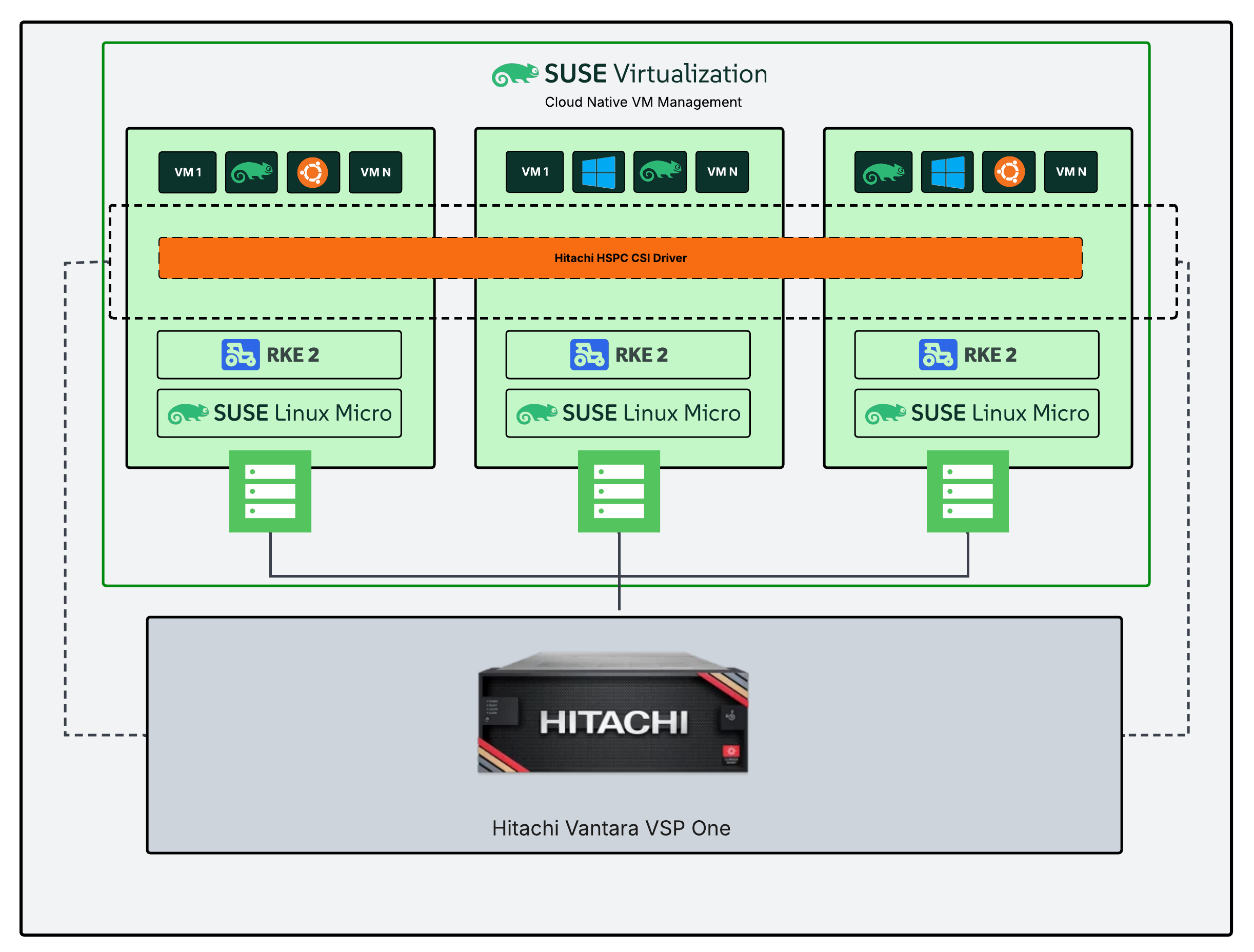
Key elements of this solution include:
- SUSE Virtualization
SUSE Virtualization delivers a fully integrated, cloud-native virtualization platform built on modern Kubernetes technologies. It simplifies VM lifecycle management, enhances platform resiliency, and provides a secure foundation for enterprise workloads. SUSE Virtualization brings the advantages of container orchestration into traditional virtualization environments, enabling organizations to modernize infrastructure without complexity.
Key SUSE Virtualization features include:High Availability
High Availability (HA) in SUSE Virtualization is grounded in a combination of Kubernetes-native resilience and enterprise storage capabilities. Rancher Kubernetes Engine 2 (RKE2) provides an HA control plane and manages cluster health, automatically restarting or relocating workloads if nodes become unresponsive. When paired with storage using multipath I/O, VM disks remain accessible across multiple storage paths, protecting against network, node, and controller failures. This ensures uninterrupted operations for critical applications.
Enhanced Security
SUSE Virtualization is a secure, pre-hardened appliance.
At its foundation is SUSE Linux Micro (SL Micro), the lightweight, enterprise, real-time Linux operating system, and Rancher Kubernetes Engine 2 (RKE2), the secure-by-default Kubernetes distribution. SL Micro’s reduced attack surface, immutable file system, and transactional updates with system rollbacks make it an ideal host for Kubernetes. SL Micro is complemented by RKE2, the secure-by-default Kubernetes distribution, which delivers the security-hardened control plane that enables robust orchestration while meeting strict government and industry compliance standards.
Additional security features of SUSE Virtualization include:
advanced network security with microsegmentation, traffic isolation, and mutual TLS (mTLS) support
secure secrets management
support for volume encryption
role-based access control (RBAC) through SUSE Rancher Prime integration
air-gapped upgrades for use in highly regulated and secure facilities
SUSE Virtualization UI
The SUSE Virtualization user interface reduces complexity and simplifies operations. It offers an intuitive, centralized dashboard for managing VMs, networks, storage, and snapshots. Administrators can easily create, clone, and migrate virtual machines without requiring deep Kubernetes knowledge.
External Storage Compatibility
SUSE Virtualization enables seamless integration with enterprise SANs like Hitachi VSP through container storage interface (CSI) drivers. Third-party storage integrations empower enterprises with choice, supporting centralized storage administration and a tailored storage experience for meeting business and technical requirements, including scaling, availability, performance, and data protection.
This guide references SUSE Virtualization v1.6 and later.
- Hitachi Vantara Virtual Storage Platform One
Hitachi VSP provides enterprise storage for backing container and virtual machine workloads. Hitachi VSP platforms are designed for mission-critical environments, delivering scalable storage solutions with unparalleled reliability. Supported platforms include Hitachi VSP, VSP One Block as well as VSP One SDS in Azure, AWS, and GCP public clouds.
- Hitachi Storage Plug-in for Containers (HSPC)
HSPC is a CSI driver that provides integration between Hitachi VSP and SUSE Virtualization, enabling you to create and use Hitachi storage volumes for stateful container applications and virtual machines. Installation, configuration, and lifecycle management of the CSI driver is handled by the HSPC CSI Operator.
This guide references HSPC v3.16.1 and later.
After implementing this integration in your SUSE Virtualization environment, you can deploy virtual machines and containers backed by Hitachi VSP storage.
3 Preparing the SUSE Virtualization environment #
In this section you prepare your environment to use Hitachi VSP storage with SUSE Virtualization.
Although you can deploy SUSE Virtualization in a single-node configuration, this is not recommended for production-grade environments where scalability, performance, and availability are important considerations. Production environments should feature at least three controller/worker nodes and a dedicated storage network.
If you have not already done so, install SUSE Virtualization.
You can access the SUSE Virtualization documentation for step-by-step installation guidance, hardware and network requirements, and further technical details.
 Tip
TipThis guide is developed with SUSE Virtualization v1.6, but you should always use the latest, supported version to avoid vulnerabilities and access the latest features.
Configure multipathd on all SUSE Virtualization worker nodes.
The multipathd service provides redundant I/O paths (iSCSI or Fibre Channel) from SUSE Virtualization worker nodes to Hitachi VSP to ensure high availability and fail-over.
For testing, you can temporarily enable multipathd by logging in to each SUSE Virtualization node and performing the following operations on the command line:
Enable and start multipathd.
systemctl enable multipathd
systemctl start multipathd
systemctl status multipathd
Create the file
/etc/multipath.conf.Be sure vendor and product rules match your array.
defaults {
    user_friendly_names yes
    find_multipaths yes

}

blacklist {
}

devices {
    device {
        vendor "(HITACHI|HP)"
        product "OPEN-.*"
        path_grouping_policy "multibus"
        path_checker "tur"
        features "0"
        failback immediate
        features "0"
        hardware_handler "0"
        prio "const"
        rr_weight uniform
        no_path_retry 10
    }
}
With
/etc/multipath.confcreated, restart the multipathd service.systemctl restart multipathdVerify that multipathd is started on each node.
systemctl status multipathd
To make these multipathd changes persistent across node reboots, you need to apply a CloudInit Custom Resource Definition (CRD).
Create the CloudInit CRD file
99-multipathd_hitachi.yaml, with content like the following:apiVersion: node.harvesterhci.io/v1beta1 kind: CloudInit metadata: name: multipathd-persistent spec: matchSelector: {} contents: | #cloud-config write_files: - path: /etc/multipath.conf permissions: '0644' owner: root:root content: | defaults { user_friendly_names yes find_multipaths yes } blacklist { } devices { device { vendor "(HITACHI|HP)" product "OPEN-.*" path_grouping_policy "multibus" path_checker "tur" features "0" failback immediate hardware_handler "0" prio "const" rr_weight uniform no_path_retry 10 } } runcmd: - systemctl enable --now multipathd - multipath -F || true - multipath -r || trueDeploy the
99-multipathd_hitachi.yamlCloudInit CRD.kubectl apply -f 99-multipathd_hitachi.yamlAfter deployment, verify that
multipath.confhas been copied to the/etcdirectory on each node.Reboot the nodes to ensure the CloudInit CRD takes full effect.
Verify that multipathd is started on each node.
4 Implementing the integration #
Integration of Hitachi VSP involves deployment of the HSPC CSI driver into your SUSE Virtualization environment. This process is described in the following sections.

You can perform the steps described here on any of the SUSE Virtualization nodes.
4.1 Installing Hitachi Storage Plug-in for Containers #
Clone the HSPC CSI Operator repository and change directory.
git clone https://github.com/hitachi-vantara/csi-operator-hitachi
cd csi-operator-hitachi/hspc/<version>/operator
Be sure to replace
<version>in the above command with the desired, available version.Create the operator namespace.
kubectl apply -f hspc-operator-namespace.yamlDeploy the operator.
kubectl apply -f hspc-operator.yamlVerify deployment of the operator.
kubectl get deployment -n hspc-operator-system
4.2 Deploying the HSPC instance #
Deploy the HSPC pods and operator controller.
Customize the file,
hspc_v1_hspc.yaml, with your namespace and settings.For example, you can set the namespace to
vsponeas follows:apiVersion: csi.hitachi.com/v1 kind: HSPC metadata: name: hspc namespace: vspone spec: {}Deploy the HSPC instance.
kubectl apply -f hspc_v1_hspc.yamlVerify HSPC pods and operator controller status.
kubectl -n vspone get hspc
kubectl -n vspone get pods | egrep 'hspc-csi-controller|hspc-csi-node'
kubectl -n hspc-operator-system get deploy hspc-operator-controller-manager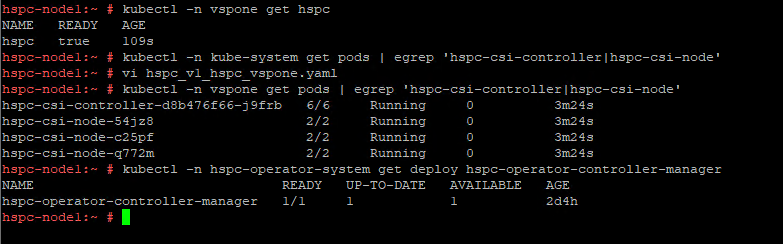
4.3 Defining a Kubernetes Secret with Hitachi VSP credentials #
For authentication, you need to provide your Hitachi VSP credentials as a Kubernetes Secret.
Encode credentials to base64 and define the Secret in
secret-vsp-112.yaml.apiVersion: v1 kind: Secret metadata: name: secret-vsp-112 namespace: vspone type: Opaque data: url: <base64-url> user: <base64-username> password: <base64-password>Create the Secret.
kubectl apply -f secret-vsp-112.yaml
4.4 Creating the StorageClass #
This provides an HSPC CSI StorageClass that can be used for PersistentVolumeClaims.
Modify the StorageClass YAML.
apiVersion: storage.k8s.io/v1
kind: StorageClass
metadata:
  name: vsp-5500-112-sc-iscsi
provisioner: hspc.csi.hitachi.com
reclaimPolicy: Delete
volumeBindingMode: Immediate
parameters:
  poolID: "<pool-id>"
  csi.storage.k8s.io/provisioner-secret-name: secret-vsp-112
  csi.storage.k8s.io/provisioner-secret-namespace: vspone
Activate the StorageClass.
kubectl apply -f storageclass.yamlVerify the StorageClass.
kubectl get sc
4.5 Creating a PersistentVolumeClaim (PVC) #
Create the file,
hitachi-pvc-50g.yamlto specify the desired storage capacity, such as 50GiB, as follows:apiVersion: v1 kind: PersistentVolumeClaim metadata: name: hitachi-pvc-50g namespace: vspone spec: accessModes: - ReadWriteOnce resources: requests: storage: 50Gi storageClassName: vsp-5500-112-sc-iscsiActivate the PVC.
kubectl apply -f hitachi-pvc-50g.yamlVerify the PVC binding.
kubectl get pvc -n vspone
4.6 Validating the configuration #
Attach the PVC to a pod to verify that storage is accessible.
This test only verifies PVC provisioning and I/O pathing. In SUSE Virtualization, volumes are attached directly to virtual machines.
Create the file,
pod.yaml, to validate mount and I/O.apiVersion: v1 kind: Pod metadata: name: hitachi-test-pod namespace: vspone spec: restartPolicy: Never containers: - name: app image: busybox command: ['sh', '-c', 'echo Hello Hitachi VSP > /data/out.txt && sleep 3600'] volumeMounts: - mountPath: /data name: hitachi-vol volumes: - name: hitachi-vol persistentVolumeClaim: claimName: hitachi-pvc-50gDeploy the test pod.
kubectl apply -f pod.yamlVerify that the test pod is running.
kubectl get pods -n vspone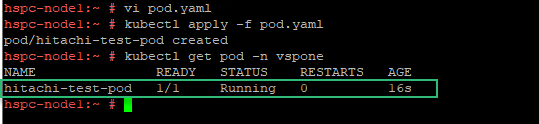
5 Enabling snapshots #
In this section, you enable snapshots to be stored on Hitachi VSP storage.
Define a VolumeSnapshotClass in the file,
volumesnapshotclass-hspc.yaml.apiVersion: snapshot.storage.k8s.io/v1 kind: VolumeSnapshotClass metadata: name: hitachi-snapclass driver: hspc.csi.hitachi.com deletionPolicy: Delete parameters: poolID: "2" csi.storage.k8s.io/snapshotter-secret-name: secret-vsp-112 csi.storage.k8s.io/snapshotter-secret-namespace: vsponeApply the VolumeSnapshotClass.
kubectl apply -f hitachi-snapclass.yamlVerify the VolumeSnapshotClass.
kubectl get VolumeSnapshotClass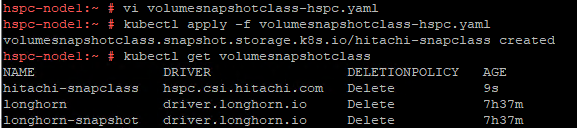
Define a VolumeSnapshot resource referencing the PVC in the file,
hitachi-snap-example.yaml.apiVersion: snapshot.storage.k8s.io/v1 kind: VolumeSnapshot metadata: name: hitachi-snap-example namespace: vspone spec: volumeSnapshotClassName: hitachi-snapclass source: persistentVolumeClaimName: hitachi-pvc-50gApply the VolumeSnapshot resource.
kubectl apply -f hitachi-snap-example.yamlVerify the VolumeSnapshot resource.
kubectl -n vspone get volumesnapshot
Configure SUSE Virtualization CSI Settings for snapshots.

In the SUSE Virtualization UI, select Advanced → Settings → csi-driver-config → Edit.
Click Add.
For Provisioner, choose or type:
hspc.csi.hitachi.com.For Volume Snapshot Class Name, enter:
hitachi-snapclass.Leave Backup Volume Snapshot Class Name blank.
Save the changes.
6 Validating Hitachi VSP storage with a VM in SUSE Virtualization #
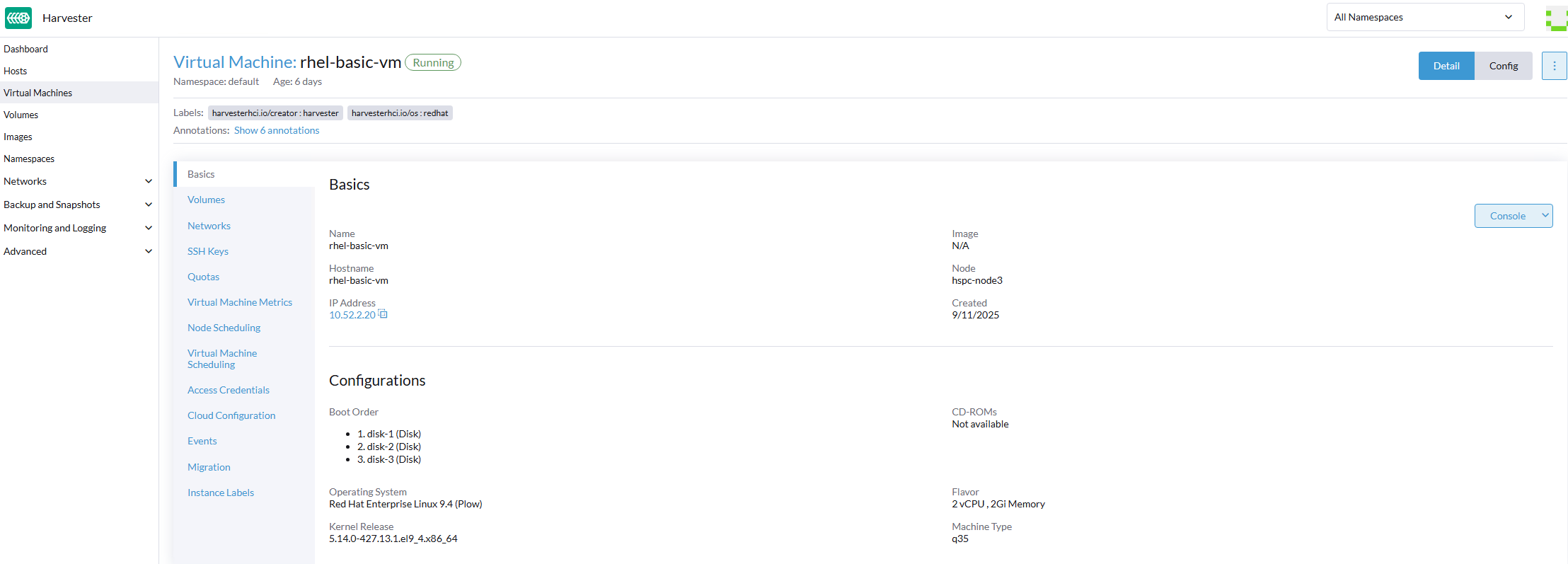
Create or edit a VM in SUSE Virtualization and choose the Hitachi StorageClass when adding disks.
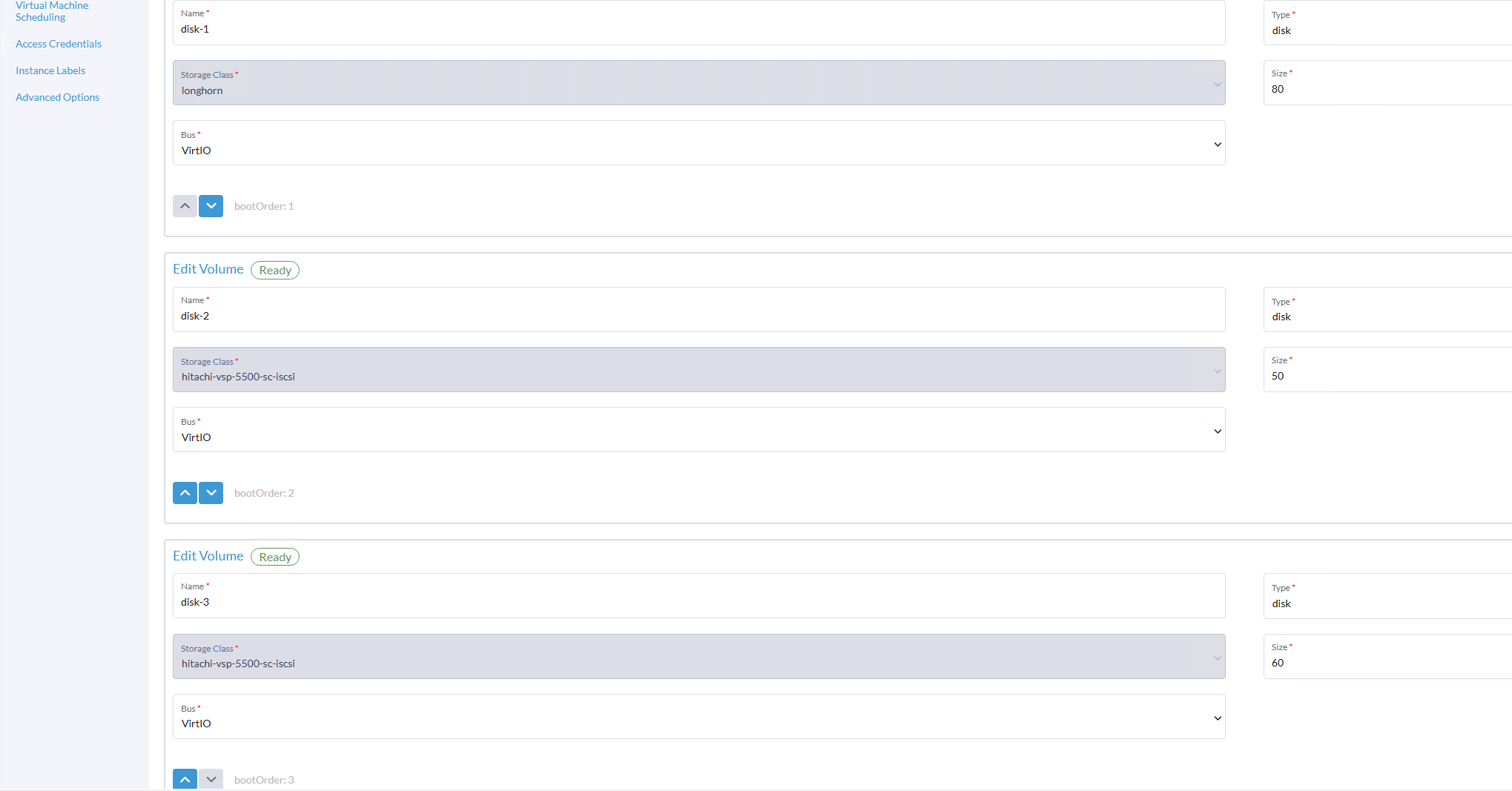
Power on the VM and verify the guest OS sees the attached disk and that I/O works.
7 Troubleshooting tips #
If the PV remains in a pending state:
Check HSPC controller logs and CSI driver pods for errors.
Make sure multipathd is enabled on all SUSE Virtualization nodes.
Use the
multipath -llcommand on the nodes to verify that configured paths and LUNs are present.Confirm base64-encoded credentials are correct and the Hitachi REST endpoint is reachable.
8 Summary #
This guide demonstrates the process for integrating Hitachi Vantara Virtual Storage Platform One with SUSE Virtualization using the Hitachi Storage Plug-in for Containers. The integration enables consistent storage services across workloads by delivering enterprise-grade reliability, dynamic storage provisioning, and snapshot capabilities.
9 Legal notice #
Copyright © 2006–2026 SUSE LLC and contributors. All rights reserved.
Permission is granted to copy, distribute and/or modify this document under the terms of the GNU Free Documentation License, Version 1.2 or (at your option) version 1.3; with the Invariant Section being this copyright notice and license. A copy of the license version 1.2 is included in the section entitled "GNU Free Documentation License".
SUSE, the SUSE logo and YaST are registered trademarks of SUSE LLC in the United States and other countries. For SUSE trademarks, see https://www.suse.com/company/legal/.
Linux is a registered trademark of Linus Torvalds. All other names or trademarks mentioned in this document may be trademarks or registered trademarks of their respective owners.
Documents published as part of the series SUSE Technical Reference Documentation have been contributed voluntarily by SUSE employees and third parties. They are meant to serve as examples of how particular actions can be performed. They have been compiled with utmost attention to detail. However, this does not guarantee complete accuracy. SUSE cannot verify that actions described in these documents do what is claimed or whether actions described have unintended consequences. SUSE LLC, its affiliates, the authors, and the translators may not be held liable for possible errors or the consequences thereof.
10 GNU Free Documentation License #
Copyright © 2000, 2001, 2002 Free Software Foundation, Inc. 51 Franklin St, Fifth Floor, Boston, MA 02110-1301 USA. Everyone is permitted to copy and distribute verbatim copies of this license document, but changing it is not allowed.
0. PREAMBLE#
The purpose of this License is to make a manual, textbook, or other functional and useful document "free" in the sense of freedom: to assure everyone the effective freedom to copy and redistribute it, with or without modifying it, either commercially or noncommercially. Secondarily, this License preserves for the author and publisher a way to get credit for their work, while not being considered responsible for modifications made by others.
This License is a kind of "copyleft", which means that derivative works of the document must themselves be free in the same sense. It complements the GNU General Public License, which is a copyleft license designed for free software.
We have designed this License in order to use it for manuals for free software, because free software needs free documentation: a free program should come with manuals providing the same freedoms that the software does. But this License is not limited to software manuals; it can be used for any textual work, regardless of subject matter or whether it is published as a printed book. We recommend this License principally for works whose purpose is instruction or reference.
1. APPLICABILITY AND DEFINITIONS#
This License applies to any manual or other work, in any medium, that contains a notice placed by the copyright holder saying it can be distributed under the terms of this License. Such a notice grants a world-wide, royalty-free license, unlimited in duration, to use that work under the conditions stated herein. The "Document", below, refers to any such manual or work. Any member of the public is a licensee, and is addressed as "you". You accept the license if you copy, modify or distribute the work in a way requiring permission under copyright law.
A "Modified Version" of the Document means any work containing the Document or a portion of it, either copied verbatim, or with modifications and/or translated into another language.
A "Secondary Section" is a named appendix or a front-matter section of the Document that deals exclusively with the relationship of the publishers or authors of the Document to the Document’s overall subject (or to related matters) and contains nothing that could fall directly within that overall subject. (Thus, if the Document is in part a textbook of mathematics, a Secondary Section may not explain any mathematics.) The relationship could be a matter of historical connection with the subject or with related matters, or of legal, commercial, philosophical, ethical or political position regarding them.
The "Invariant Sections" are certain Secondary Sections whose titles are designated, as being those of Invariant Sections, in the notice that says that the Document is released under this License. If a section does not fit the above definition of Secondary then it is not allowed to be designated as Invariant. The Document may contain zero Invariant Sections. If the Document does not identify any Invariant Sections then there are none.
The "Cover Texts" are certain short passages of text that are listed, as Front-Cover Texts or Back-Cover Texts, in the notice that says that the Document is released under this License. A Front-Cover Text may be at most 5 words, and a Back-Cover Text may be at most 25 words.
A "Transparent" copy of the Document means a machine-readable copy, represented in a format whose specification is available to the general public, that is suitable for revising the document straightforwardly with generic text editors or (for images composed of pixels) generic paint programs or (for drawings) some widely available drawing editor, and that is suitable for input to text formatters or for automatic translation to a variety of formats suitable for input to text formatters. A copy made in an otherwise Transparent file format whose markup, or absence of markup, has been arranged to thwart or discourage subsequent modification by readers is not Transparent. An image format is not Transparent if used for any substantial amount of text. A copy that is not "Transparent" is called "Opaque".
Examples of suitable formats for Transparent copies include plain ASCII without markup, Texinfo input format, LaTeX input format, SGML or XML using a publicly available DTD, and standard-conforming simple HTML, PostScript or PDF designed for human modification. Examples of transparent image formats include PNG, XCF and JPG. Opaque formats include proprietary formats that can be read and edited only by proprietary word processors, SGML or XML for which the DTD and/or processing tools are not generally available, and the machine-generated HTML, PostScript or PDF produced by some word processors for output purposes only.
The "Title Page" means, for a printed book, the title page itself, plus such following pages as are needed to hold, legibly, the material this License requires to appear in the title page. For works in formats which do not have any title page as such, "Title Page" means the text near the most prominent appearance of the work’s title, preceding the beginning of the body of the text.
A section "Entitled XYZ" means a named subunit of the Document whose title either is precisely XYZ or contains XYZ in parentheses following text that translates XYZ in another language. (Here XYZ stands for a specific section name mentioned below, such as "Acknowledgements", "Dedications", "Endorsements", or "History".) To "Preserve the Title" of such a section when you modify the Document means that it remains a section "Entitled XYZ" according to this definition.
The Document may include Warranty Disclaimers next to the notice which states that this License applies to the Document. These Warranty Disclaimers are considered to be included by reference in this License, but only as regards disclaiming warranties: any other implication that these Warranty Disclaimers may have is void and has no effect on the meaning of this License.
2. VERBATIM COPYING#
You may copy and distribute the Document in any medium, either commercially or noncommercially, provided that this License, the copyright notices, and the license notice saying this License applies to the Document are reproduced in all copies, and that you add no other conditions whatsoever to those of this License. You may not use technical measures to obstruct or control the reading or further copying of the copies you make or distribute. However, you may accept compensation in exchange for copies. If you distribute a large enough number of copies you must also follow the conditions in section 3.
You may also lend copies, under the same conditions stated above, and you may publicly display copies.
3. COPYING IN QUANTITY#
If you publish printed copies (or copies in media that commonly have printed covers) of the Document, numbering more than 100, and the Document’s license notice requires Cover Texts, you must enclose the copies in covers that carry, clearly and legibly, all these Cover Texts: Front-Cover Texts on the front cover, and Back-Cover Texts on the back cover. Both covers must also clearly and legibly identify you as the publisher of these copies. The front cover must present the full title with all words of the title equally prominent and visible. You may add other material on the covers in addition. Copying with changes limited to the covers, as long as they preserve the title of the Document and satisfy these conditions, can be treated as verbatim copying in other respects.
If the required texts for either cover are too voluminous to fit legibly, you should put the first ones listed (as many as fit reasonably) on the actual cover, and continue the rest onto adjacent pages.
If you publish or distribute Opaque copies of the Document numbering more than 100, you must either include a machine-readable Transparent copy along with each Opaque copy, or state in or with each Opaque copy a computer-network location from which the general network-using public has access to download using public-standard network protocols a complete Transparent copy of the Document, free of added material. If you use the latter option, you must take reasonably prudent steps, when you begin distribution of Opaque copies in quantity, to ensure that this Transparent copy will remain thus accessible at the stated location until at least one year after the last time you distribute an Opaque copy (directly or through your agents or retailers) of that edition to the public.
It is requested, but not required, that you contact the authors of the Document well before redistributing any large number of copies, to give them a chance to provide you with an updated version of the Document.
4. MODIFICATIONS#
You may copy and distribute a Modified Version of the Document under the conditions of sections 2 and 3 above, provided that you release the Modified Version under precisely this License, with the Modified Version filling the role of the Document, thus licensing distribution and modification of the Modified Version to whoever possesses a copy of it. In addition, you must do these things in the Modified Version:
Use in the Title Page (and on the covers, if any) a title distinct from that of the Document, and from those of previous versions (which should, if there were any, be listed in the History section of the Document). You may use the same title as a previous version if the original publisher of that version gives permission.
List on the Title Page, as authors, one or more persons or entities responsible for authorship of the modifications in the Modified Version, together with at least five of the principal authors of the Document (all of its principal authors, if it has fewer than five), unless they release you from this requirement.
State on the Title page the name of the publisher of the Modified Version, as the publisher.
Preserve all the copyright notices of the Document.
Add an appropriate copyright notice for your modifications adjacent to the other copyright notices.
Include, immediately after the copyright notices, a license notice giving the public permission to use the Modified Version under the terms of this License, in the form shown in the Addendum below.
Preserve in that license notice the full lists of Invariant Sections and required Cover Texts given in the Document’s license notice.
Include an unaltered copy of this License.
Preserve the section Entitled "History", Preserve its Title, and add to it an item stating at least the title, year, new authors, and publisher of the Modified Version as given on the Title Page. If there is no section Entitled "History" in the Document, create one stating the title, year, authors, and publisher of the Document as given on its Title Page, then add an item describing the Modified Version as stated in the previous sentence.
Preserve the network location, if any, given in the Document for public access to a Transparent copy of the Document, and likewise the network locations given in the Document for previous versions it was based on. These may be placed in the "History" section. You may omit a network location for a work that was published at least four years before the Document itself, or if the original publisher of the version it refers to gives permission.
For any section Entitled "Acknowledgements" or "Dedications", Preserve the Title of the section, and preserve in the section all the substance and tone of each of the contributor acknowledgements and/or dedications given therein.
Preserve all the Invariant Sections of the Document, unaltered in their text and in their titles. Section numbers or the equivalent are not considered part of the section titles.
Delete any section Entitled "Endorsements". Such a section may not be included in the Modified Version.
Do not retitle any existing section to be Entitled "Endorsements" or to conflict in title with any Invariant Section.
Preserve any Warranty Disclaimers.
If the Modified Version includes new front-matter sections or appendices that qualify as Secondary Sections and contain no material copied from the Document, you may at your option designate some or all of these sections as invariant. To do this, add their titles to the list of Invariant Sections in the Modified Version’s license notice. These titles must be distinct from any other section titles.
You may add a section Entitled "Endorsements", provided it contains nothing but endorsements of your Modified Version by various parties—for example, statements of peer review or that the text has been approved by an organization as the authoritative definition of a standard.
You may add a passage of up to five words as a Front-Cover Text, and a passage of up to 25 words as a Back-Cover Text, to the end of the list of Cover Texts in the Modified Version. Only one passage of Front-Cover Text and one of Back-Cover Text may be added by (or through arrangements made by) any one entity. If the Document already includes a cover text for the same cover, previously added by you or by arrangement made by the same entity you are acting on behalf of, you may not add another; but you may replace the old one, on explicit permission from the previous publisher that added the old one.
The author(s) and publisher(s) of the Document do not by this License give permission to use their names for publicity for or to assert or imply endorsement of any Modified Version.
5. COMBINING DOCUMENTS#
You may combine the Document with other documents released under this License, under the terms defined in section 4 above for modified versions, provided that you include in the combination all of the Invariant Sections of all of the original documents, unmodified, and list them all as Invariant Sections of your combined work in its license notice, and that you preserve all their Warranty Disclaimers.
The combined work need only contain one copy of this License, and multiple identical Invariant Sections may be replaced with a single copy. If there are multiple Invariant Sections with the same name but different contents, make the title of each such section unique by adding at the end of it, in parentheses, the name of the original author or publisher of that section if known, or else a unique number. Make the same adjustment to the section titles in the list of Invariant Sections in the license notice of the combined work.
In the combination, you must combine any sections Entitled "History" in the various original documents, forming one section Entitled "History"; likewise combine any sections Entitled "Acknowledgements", and any sections Entitled "Dedications". You must delete all sections Entitled "Endorsements".
6. COLLECTIONS OF DOCUMENTS#
You may make a collection consisting of the Document and other documents released under this License, and replace the individual copies of this License in the various documents with a single copy that is included in the collection, provided that you follow the rules of this License for verbatim copying of each of the documents in all other respects.
You may extract a single document from such a collection, and distribute it individually under this License, provided you insert a copy of this License into the extracted document, and follow this License in all other respects regarding verbatim copying of that document.
7. AGGREGATION WITH INDEPENDENT WORKS#
A compilation of the Document or its derivatives with other separate and independent documents or works, in or on a volume of a storage or distribution medium, is called an "aggregate" if the copyright resulting from the compilation is not used to limit the legal rights of the compilation’s users beyond what the individual works permit. When the Document is included in an aggregate, this License does not apply to the other works in the aggregate which are not themselves derivative works of the Document.
If the Cover Text requirement of section 3 is applicable to these copies of the Document, then if the Document is less than one half of the entire aggregate, the Document’s Cover Texts may be placed on covers that bracket the Document within the aggregate, or the electronic equivalent of covers if the Document is in electronic form. Otherwise they must appear on printed covers that bracket the whole aggregate.
8. TRANSLATION#
Translation is considered a kind of modification, so you may distribute translations of the Document under the terms of section 4. Replacing Invariant Sections with translations requires special permission from their copyright holders, but you may include translations of some or all Invariant Sections in addition to the original versions of these Invariant Sections. You may include a translation of this License, and all the license notices in the Document, and any Warranty Disclaimers, provided that you also include the original English version of this License and the original versions of those notices and disclaimers. In case of a disagreement between the translation and the original version of this License or a notice or disclaimer, the original version will prevail.
If a section in the Document is Entitled "Acknowledgements", "Dedications", or "History", the requirement (section 4) to Preserve its Title (section 1) will typically require changing the actual title.
9. TERMINATION#
You may not copy, modify, sublicense, or distribute the Document except as expressly provided for under this License. Any other attempt to copy, modify, sublicense or distribute the Document is void, and will automatically terminate your rights under this License. However, parties who have received copies, or rights, from you under this License will not have their licenses terminated so long as such parties remain in full compliance.
10. FUTURE REVISIONS OF THIS LICENSE#
The Free Software Foundation may publish new, revised versions of the GNU Free Documentation License from time to time. Such new versions will be similar in spirit to the present version, but may differ in detail to address new problems or concerns. See http://www.gnu.org/copyleft/.
Each version of the License is given a distinguishing version number. If the Document specifies that a particular numbered version of this License "or any later version" applies to it, you have the option of following the terms and conditions either of that specified version or of any later version that has been published (not as a draft) by the Free Software Foundation. If the Document does not specify a version number of this License, you may choose any version ever published (not as a draft) by the Free Software Foundation.
ADDENDUM: How to use this License for your documents#
Copyright (c) YEAR YOUR NAME.
   Permission is granted to copy, distribute and/or modify this document
   under the terms of the GNU Free Documentation License, Version 1.2
   or any later version published by the Free Software Foundation;
   with no Invariant Sections, no Front-Cover Texts, and no Back-Cover Texts.
   A copy of the license is included in the section entitled “GNU
   Free Documentation License”.
If you have Invariant Sections, Front-Cover Texts and Back-Cover Texts, replace the “ with…Texts.” line with this:
with the Invariant Sections being LIST THEIR TITLES, with the
   Front-Cover Texts being LIST, and with the Back-Cover Texts being LIST.
If you have Invariant Sections without Cover Texts, or some other combination of the three, merge those two alternatives to suit the situation.
If your document contains nontrivial examples of program code, we recommend releasing these examples in parallel under your choice of free software license, such as the GNU General Public License, to permit their use in free software.