
Multiple Servers with Hub to Manage Large Scale Deployments
If you need to manage a large number of clients, in most cases you can do so with a single SUSE Multi-Linux Manager Server, tuned appropriately.
However, if you need to manage tens of thousands of clients, you might find it easier to use one of the following mechanisms:
ISS version 2 is based on exporting data from one server (source) and importing it on another (target) server. It is useful for disconnected setups.
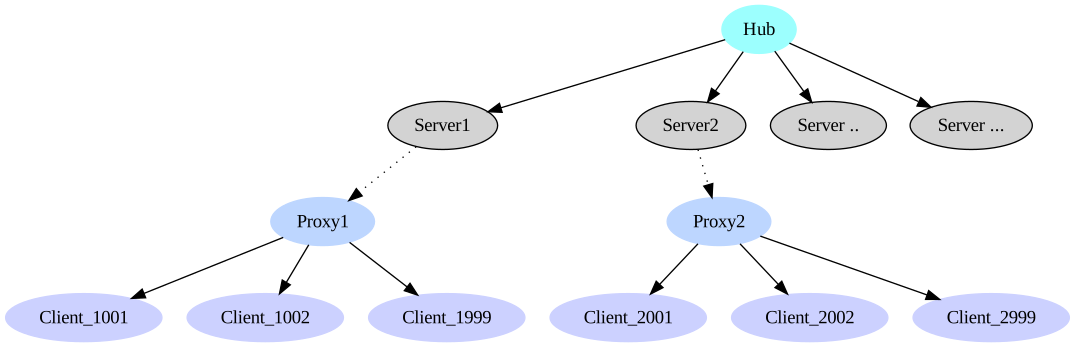
SUSE Multi-Linux Manager Hub helps managing very large deployments by connecting multiple servers together. The connection between the Hub and its peripheral servers is established using Hub Online Synchronization. The typical Hub topology looks like this:
-
One central SUSE Multi-Linux Manager Server, which acts as the Hub Server.
-
One or more additional SUSE Multi-Linux Manager Servers, registered to the Hub. This document refers to these additional servers as peripheral servers.
-
Any number of clients registered to the peripheral servers. Some of these clients can act as SUSE Multi-Linux Manager Proxies.
This chapter gives more details about Hub deployment.